

Filling the gaps of the Archive: The Secret Diary of William Byrd II
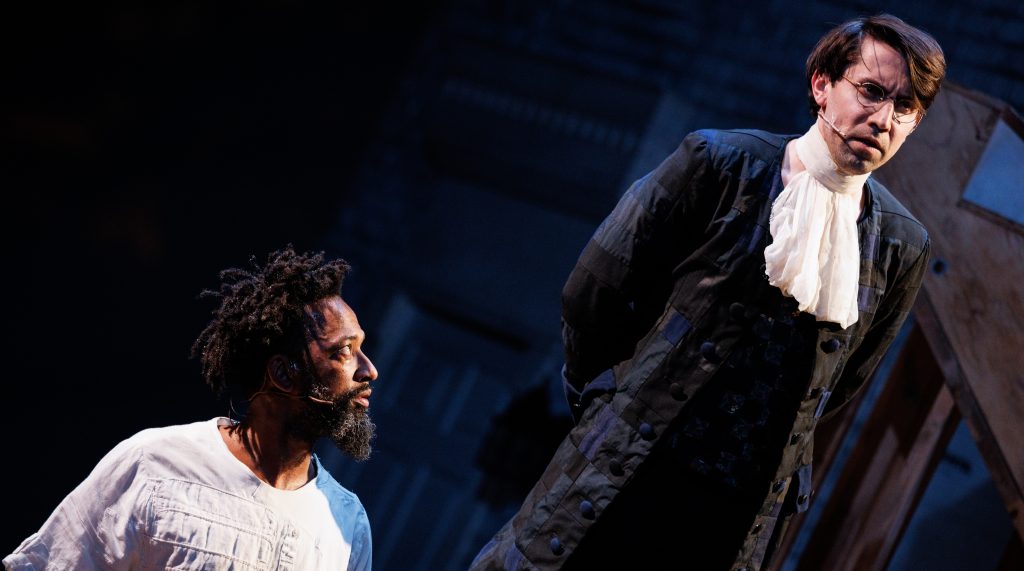
The following was written based on an interview with James Harrison Monaco conducted in October of 2025.
How can we know our collective story if only the voices of those in power are preserved in the archive? What can we gain through artistic imaginings of individuals from the margins of the written record? These are questions that members of the TEAM grappled with during the writing of RECONSTRUCTING, taking as a starting point the secret diary of William Byrd II of Westover, 1709-1712.
William Byrd II (1674 to 1744) was a prominent enslaver and plantation owner in Richmond, Virginia. He kept a diary from 1709 to 1712 that has come to be known as the “secret diary” of William Byrd of Westover, likely because he wrote in a code later translated by scholars. In it, he recorded his daily life, including mentions of a Eugene and Jenny, who are assumed to have been enslaved or indentured based on context and the fact that they are referred to only by first name. Members of The TEAM were particularly struck with the mundanity of the diary and the ways in which acts of violence committed by Byrd against Eugene and Jenny are written about in much the same way as Byrd writes about reading the bible or drinking milk.1
James Harrison Monaco, RECONSTRUCTING writer and composer, brought the diary to the collective. The TEAM makes theatre through a highly iterative, collaborative writing process driven by prompts. Prompts may be offered to the full company or exchanged between individuals, and dozens, sometimes hundreds, are posed and answered as a piece develops. Material that resonates most deeply is revisited and ultimately incorporated into the script.
One prompt, posed to white-identifying members of the TEAM, asked artists to explore white supremacist writings from the past as part of their heritage. James sought out writings by enslavers from his home state of Virginia. He had vaguely known of William Byrd II, as he’s considered the founder of Richmond and is the namesake of many a park and theatre. James first found excerpts of the diary online and later checked the volume out of the Brooklyn Public Library.
As James spent time with the diary, he began to feel deeply unsettled by similarities he observed between Byrd and himself. An entry from Byrid’s diary dated April 7, 1709 reads:
I rose before 6 o’clock and read two chapters in Hebrew and 250 verses in Homer’s Odyssey and made an end of it. I said my prayers devoutly. I ate milk for breakfast. I danced my dance.
“The more I looked at them… there were things in them – not the explicit enslaving violence – that reminded me of myself. I am extremely routine based. I wake up at the same time every day and I’m very studious. I’m sort of autodidactic; I’m going to read five pages of Spanish from 6:00 – 6:30 am, and then I am going to work on my French from 6:30 – 7:15, and then I am going to read a religious text until 8:00 am, and then I’m going to pray, and then I am going to work on my own writings. I do record that stuff in diaries. So I started to be like, ‘oh… there’s some of me here, which was troubling.’”
James found these parallels troubling but also generative. Byrd’s diary is largely illegible in its original form due to the shorthand code he invented. That code, coupled with the violence peppered throughout otherwise banal entries, had James reflecting on how society rationalizes the moral character of enslavers. “Byrd seem[ed] so normal and so sociopathic at the same time. It’s often debated whether enslavers were sociopathic. I think there’s a case to be made for that. But others [claim] that [excuse] is a cop out. [Slavery] was so widely accepted. [To imply that all enslavers were sociopathic] is a way of not examining one’s own form of being an oppressor nowadays. There is something interesting and divisive there,” James suggested. “So many people want to disinherit a lot of the more unfortunate, more violent histories,” but what happens when we confront those histories and learn how to live with them?
At one point, James began to lose interest in Byrd. “His diaries are so boring most of the time and I find him repulsive in many ways. Eventually, there was a long gap between TEAM residences and I felt like, ‘I don’t think this character applies anymore.’” He went to return the book, only to discover that the library had transitioned to a new cataloging system and the diary was no longer in it. Even though the book was stamped BROOKLYN PUBLIC LIBRARY, the staff would not take it back. “You have to keep it,” the librarian said. The moment mirrored what was happening in the writing room. While James felt his interest fading, the rest of the TEAM pushed him to interrogate that resistance. “We haven’t lost interest and you should play him in the show,” his collaborators insisted.
James ultimately found himself playing William Byrd II in RECONSTRUCTING. Modesto “Flako” Jimenez plays Eugene, based on the real individual mentioned in the diary. Eugene was written into RECONSTRUCTING in an effort to reclaim a person from the past whose only record exists within the diary of his enslaver. “Two people get named in the Willian Byrd diaries, Jenny and Eugene. We know little about either… They get mentioned and your only access to them is this [limited] specific view. On one hand, you want to destroy the diary [because] you’re mad at it. But in another sense, not erasing the violence in the history feels important. It’s our only access to Jenny and Eugene.”
The TEAM had to work their way toward accepting that any reimagining of Eugene would be conjecture, given that for “every 48 pages of William Byrd’s life [there are] two sentences mentioning Jenny and Eugene.” James and his collaborators wanted to explore what would happen if they gave Eugene the space he was denied in the historical record. Over the course of the show, the character of Eugene “grows and grows and grows. [Taking on increasing] importance and [begins] to take on his own life.” He interacts with and influences other characters across space and time and is given a level of depth and agency the real Eugene was denied in the William Byrd diary.
What do we do when someone’s whole life is represented by fleeting accounts of violence in the archive? What do we gain by “letting artistic voice into that person, even if its not true?” Bringing Eugene to life became one way the TEAM grappled with the uneven nature of the historical record in the United States and its gaps. It helped them hold the reality that many Black ancestors have been lost, and that what remains often survives only in the written accounts of white men who controlled their lives. James had to wrestle with seeing himself in a historic enslaver and hold the violence of that history, while his Black collaborators found the agency to imagine what their ancestors might have been like if they could speak for themselves. While an artistic interpretation of a real person from the margins of history might not be “factually, historically, identifiably true, [it can] occupy some other place of truth,” and that can be healing.
Photo credit: Maria Baranova-Suzuki
- You can read the diary in full via the Internet Archive: https://archive.org/details/secretdiaryofwil0000byrd/mode/2up ↩︎