

Audience Advocates
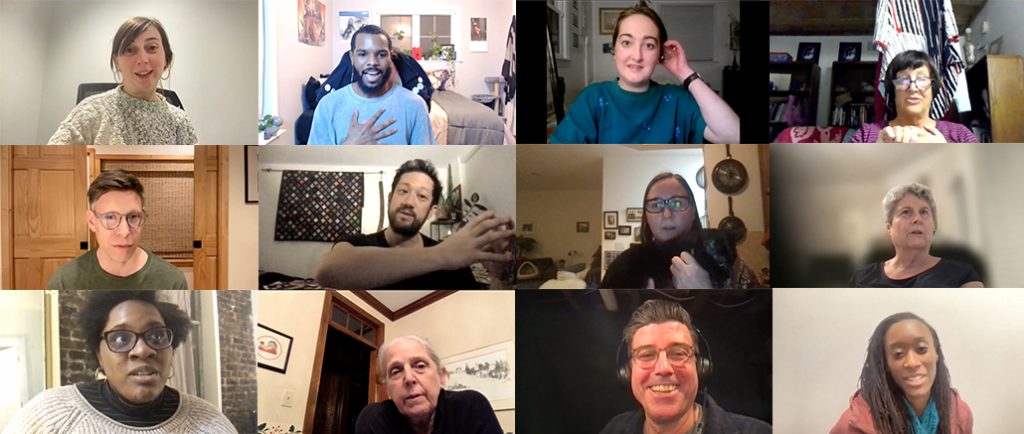
An eclectic group of Triangle folks made up of dancers, CPA Board members, writers, retirees, and students met via zoom on Tuesdays and Thursday evenings in the spring of 2022 for Advanced Beginner Group’s session of Audience Advocates. They were in the zoom room to dig into Advanced Beginner Group’s creative process and contribute to the development of a forthcoming project. The group began by watching and discussing Primer for an Impossible Conversation, a virtual theatre piece intended to continue the conversation begun in ABG’s Distances Smaller Than This Are Not Confirmed. Melanie George, ABG’s dramaturg, visited another session and shared what it was like being the ‘doula’ for Distances. Participants spent the final meeting collaborating on a digital mood-board that ABG used to collect ideas for their forthcoming Rich With History and Other Stuff You Say at a Haunted House.
A Visit from Dramaturg Melanie George
Melanie George visited Audience Advocates and talked with the group about her experience serving as the dramaturg for Distances Smaller Than This Are Not Confirmed. David and Marcella reflected on the ways in which Distances changed due to Melanie’s involvement, while the advocates were able to ask Melanie questions that gave them deeper insight into the evolution of the work.
“I often refer to myself as the midwife or the doula for the work. It’s not going to have my name and I’m not going to move on with it as it grows up in life but I’m going to help bring it into the world,” Melanie shared. Indeed, the role of a dramaturg is part doula, part assistant, part therapist, and part holistic detective (at least according to ABG and Melanie). It was Melanie’s job to come into the work and offer an outside perspective, ask questions, and point out things that ABG might not have been able to see from their places deep within the project. Ultimately, it was Melanie’s responsibility to, “help the artists get closer to making the best version of the thing that they’re trying to make and also identifying if the thing that they say they’re making is the thing that they’re actually making.”
Melanie and Marcella shared about the unique and intimate relationship that they cultivated, one that centered around the often invisible but heavy work of being a Black woman engaged in conversations about race. Marcella found herself in a place without hard boundaries around sharing personal stories, pains, and traumas prior to Melanie’s dramaturgical guidance. “There were so many things that I didn’t even I didn’t realize that I needed help in the ways that Melanie was looking out for me. The questions she was asking me — like ‘what does she owe an audience in terms of reliving trauma and hurt as a black woman?’ – were ones that hadn’t been asking myself.” This work helped Marcella to move to a space where she didn’t have to give so much of herself to the work. Melanie shared that this specific kind of dramaturgy was unlike anything she had experienced before or after. Here, the dramaturgical relationship was mutually impactful.
David reflected that Melanie’s impact on Distances was profound, and she helped him shift to a place of leading with care. Marcella was telling personal stories in the early iterations of the work and Melanie pushed the artists away from this model. “At what point do the stakes become high for you?” Melanie asked David. “How do you tell the stories that raise the stakes for you? Because they are already high for Marcella.” This kind of feedback was critical to ensuring that David and Marcella weren’t repeating the patterns of the very fraught and often unsuccessful conversations about race that inspired them to embark on their own. Melanie reflected that often, “white folks can talk about racism and they never have to actually be in the Center of that racism. They can be outside of it. It was important that we didn’t allow that to happen in the work, because it would be the antithesis of the thing we were trying to do.” It was through careful and regular relationship building between the dramaturg and the artists that they were able to get to a place where these frank conversations could happen and thus propel the work closer to its final and most honest form.
Collective Research: The Milanote Board
ABG invited the group to explore and contribute to their virtual Milanote mood board during the final meeting of Audience Advocates. Tei and Marcella explained how the group used the board to collect ideas for their forthcoming work (Rich With History and Other Stuff You Say at a Haunted House) and the advocates got to work adding ideas, images, and links to the board.
ABG was in the very early phases of research for Rich With History and thus no idea was too wacky or niche. Ideas about A.I., D.E.I. at Universities, Afro-futurism, puppetry and turtles (Marcella’s favorite animal) were swirling around in the artists’ heads. In the video clip below, Tei (ABG) and Jasmine (Audience Advocate participant) talk about the concept of ‘middle gray’ and how it relates to the racial bias inherent in photography. As you can imagine, each item on the mood board held the potential for deep discussion and conversation amongst the artists and participants.
The Advocates Reflect
Audience Advocates participants Paura Heo, Johnathan Holt, Anthony ‘Otto’ Nelson Jr., and Jasmine Powell each wrote a reflection about their experience with Advanced Beginner Group and the other advocates. They were asked to respond to the following prompt:
How does your lived experience challenge, inform, or affect your experience of Audience Advocates? Respond to how community is built in this virtual space and consider how who you are and/or where you come from impacts how you feel and participate in this program.
The advocates also attended Distances and met up with ABG after the show to connect face-to-face for the first time since meeting virtually. Paura, and Jonathan responded to Distances and you can read their thoughts here: