

Limits of Repair
The following was written based on an interview with Jillian Walker conducted in October of 2025.
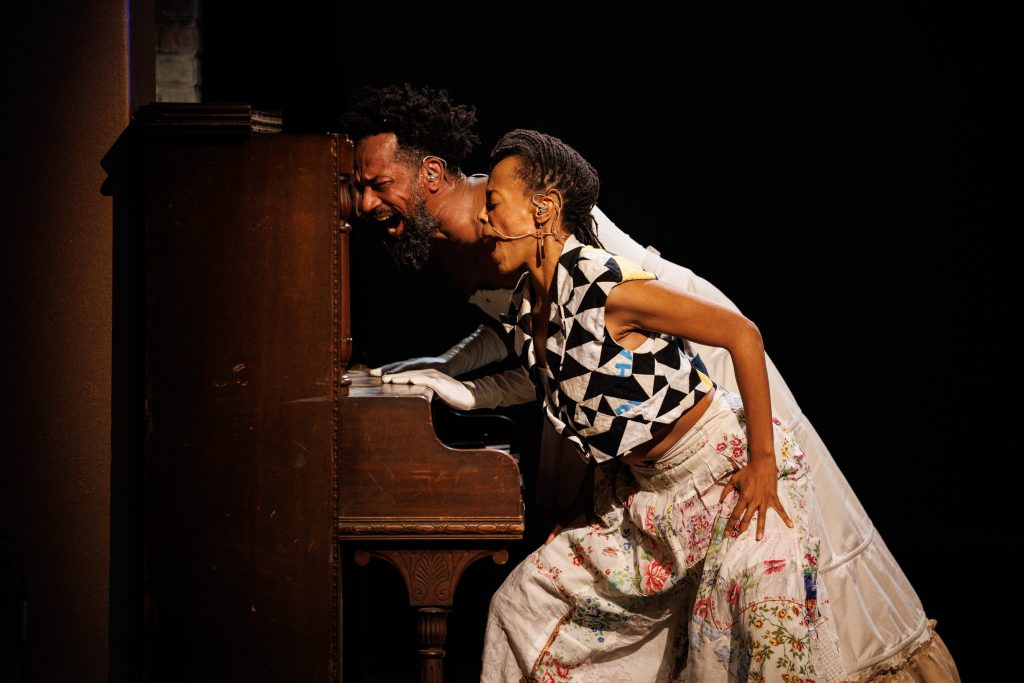
Much of what appears on the stage of RECONSTRUCTING reflects the very processes through which the TEAM moved toward the final production. The quilted costumes and props are no exception. Performer and writer Jillian Walker wears a pair of pants quilted entirely from her late grandmother’s handkerchief collection.
The quilt looms large in RECONSTRUCTING and represents many essential aspects of the project. Quilting has long been a strong Black tradition rooted equally in creativity, resourcefulness, and survival. It also serves as a potent metaphor for what the TEAM undertook: taking small pieces of themselves and their histories and reworking them into something new that is necessary, beautiful, and hopefully even functional. Jillian’s quilted pants quietly symbolize her family lineage while acting as a guiding object in questioning how we carry and navigate the fraught and delicate histories we inherit, and how we care for ourselves in the process. Ultimately, they provoke a central question, whether in the context of a physical object or an interpersonal relationship: what are the limits of repair.
Over the last several years of the RECONSTRUCTING creation process, Jillian and her family have been engaged in the careful and often heavy work of cleaning out the home that belonged to her maternal grandparents. The process required deciding what to give away, what to sell, and what would remain as a living, tangible connection to the family’s lineage. Among the many items in the house were several drawers of handkerchiefs. Jillian’s grandmother, Juanita, had amassed a large collection over her lifetime. As the steward of the family home, Juanita “had everybody’s stuff,” Jillian recalled, and those drawers likely held the handkerchiefs and histories of many women in the family.
RECONSTRUCTING costume designers Brenda Abbandandolo, Markia Kent, and Kristen Sieh had asked members of the TEAM to contribute scraps and fabric for quilts that would become the material and visual vocabulary of the show through costumes and props. “When I opened that drawer and there were all of these handkerchiefs inside… I immediately thought of the three of them.” Jillian kept about forty handkerchiefs for herself and brought a drawer’s worth to the costume team.1
“When I arrived at our workshop last year, I saw Kristen in the back of the room, sewing these handkerchiefs together, still not realizing [what she was making although] I recognized the material. One of the beautiful things about that workshop was that we had [all the] designers in one room as we were continuing to create the show… There was a little sewing station in the back of the room, and I got to look up every once in a while and see Kristen sewing back there.” Eventually, Kristen revealed that they had transformed Juanita’s Esther’s handkerchiefs into a pair of pants for Jillian to wear in the production.
Upon learning this, Jillian said, “I cried, of course.” Seeing her grandmother’s possessions rendered as a wearable work of art confirmed Jillian’s deep knowledge that RECONSTRUCTING was more than a performance and the pants were more than just a costume. The pants were “an entry way into a true practice of what it is to reconstruct a thing. I came with these separate pieces, this material that meant something to me [despite not knowing] the story behind every single handkerchief. Seeing them put together, into a new thing, something that was mine that I would be doing my work in… whatever work was done with those handkerchiefs before, now the work is going to be done by me and in a different way. I’m not carrying the handkerchiefs in my hands; I’m wearing them on my body.” Though the form of the fabric had changed from handkerchiefs to pants, the potency of inheritance remained strong.
For Jillian, cleaning out her grandparents’ home with her family paralleled creating RECONSTRUCTING with her TEAM collaborators in a way that felt too powerful to be coincidence. In both processes, “what are we keeping and what are we getting rid of” functioned as both metaphor and practical question. “The house in RECONSTRUCTING came first, before the mirroring that my life brought in the [form of my grandparents’ house]. That is something that I am amazed by; that the language about the house that I have been drawing on philosophically became a [kind of] personal oracle.” The blending of her creative and family life, and the space for reflection it created, was not lost on her.
Through these parallel undertakings, “more language was generated, specifically around inheritance. [Particularly] bigger questions of what do we do with these things that we inherit?” In a family, “these things” might be furniture, handkerchiefs, or photographs. They might also be intangible inheritances such as stories, secrets, and trauma. In RECONSTRUCTING, the collective grappled with the inheritance of America’s original sin of slavery and the innumerable ways it continues to shape our lives. What did they want to do with what they had inherited? How could they hold it responsibly without allowing it entirely to dictate how they built trust and intimacy together?
The convergence of these two spheres of her life made sense to Jillian. “You’re doing this work in your life and in your art because one thing is supposed to help the other. That’s your assignment for the time being. It’s one of the signatures of what we are doing here in RECONSTRUCTING: everyone is bringing something in. The material itself is holding the history and that means that we are carriers of those histories.” By offering materials and their histories to the group, the TEAM members opened themselves to sharing the weight and collectively deciding what to carry forward and what to release.
This required navigation. Within both her family and the TEAM — systems of people who care for one another and must meet challenges together — Jillian found herself asking, “what is my responsibility in this?” She reflected that she has historically had “a much stronger tendency toward over-responsibility, toward taking on more than was actually my share. Trying to hold up and prop up things that weren’t mine to do… [in my work with both my family and the TEAM] I am really learning to only take responsibility for what I actually want to inherit. That is what I am reconstructing.” In RECONSTRUCTING, each individual had to take responsibility for what was theirs to carry, working collectively to ensure that great care was taken when considering what the Black and white members should hold or let go.
Closely linked to inheritance is another question asked throughout RECONSTRUCTING: “Will you leave the house, or will you stay? What are the consequences of saying goodbye?” The question, which became a key lyric in a song Jillian wrote for the production, is layered in its relationship to legacy. It invites us to be more deliberate about what we choose to carry forward. It asks what it means to say goodbye to an item or a pattern within a family or a country.
“Consequences are not necessarily bad,” Jillian said. In RECONSTRUCTING, there is the metaphor “of the house as this country… When I sing the question [in the production]… it’s a prayer for me. I don’t have an answer… I hope and I pray that other people… want to be with me to figure out what the consequences of saying goodbye are and how we can be with whatever those consequences are.” While we do not choose what we inherit, we can choose what we do with that inheritance, and there is power in that.
“There is something very beautiful and also challenging about [the] delicacy [of the pants] because they are made of handkerchiefs.” Jillian shared that she and the costume team had to experiment carefully with what she could and could not do while wearing a “vintage family heirloom” on her body. “There’s something very alive in their delicacy. [We] really have to think about [delicacy] as we consider keeping things. Certain things, if they’re going to be kept, must be kept gently… otherwise they will fall apart,” she mused. Of course, things can be repaired, but only so many times. “What does it mean to repair it? What are the implications for repair and when can it no longer be repaired? And what does that mean?” These questions resonate beyond the garment itself. They speak directly to how the Black and white members of the TEAM must work together within the broader context of a society.
What are the limits of repair, and how do those limits shape how we show up? “Before [RECONSTRUCTING] I understood that there are limits, but in my heart I was like, ‘there are no limits to repair! It’s all repairable all the time.’ Through this process, as well as through the mirroring of my work with my own family, I [have realized] there are limits to repair.” The TEAM believes that how they make is just as important as what they make. As individuals and as a collective, they had to reckon with the legacies they inherited, decide what to say goodbye to, and define how to show up knowing that repair has real limits within their relationships.
“I think it’s a really important question for the nation to reckon with. If you work under the assumption that everything can be repaired indefinitely, how do you show up? If I know I can wear these pants six times and then they’re going to turn into dust, I’m going to be very careful and intentional about when and how I wear those pants. How do you show up when you really and truly recognize that you cannot show up forever?”
In the end, the quilting practice at the center of RECONSTRUCTING came to embody the spirit of the TEAM’s journey: an act of piecing together fragments of memory, national lineage, and lived experience into a form that is at once necessary and expressive. As both object and metaphor, Jillian’s pants gesture toward the care required to tend inherited stories and the courage needed to confront their fragility. The TEAM wrestled with the difficult truth that repair is not infinite; some seams will hold, while others mark the edge of what is possible. Yet by embracing vulnerability and sustained reflection they transformed this work of repair into an opportunity for deeper understanding and intimacy. RECONSTRUCTING does not offer easy answers about the boundaries of repair, but instead honors the labor of attempting it, even when the limits come into view.
-

Photo by Maria Baranova-Suzuki -
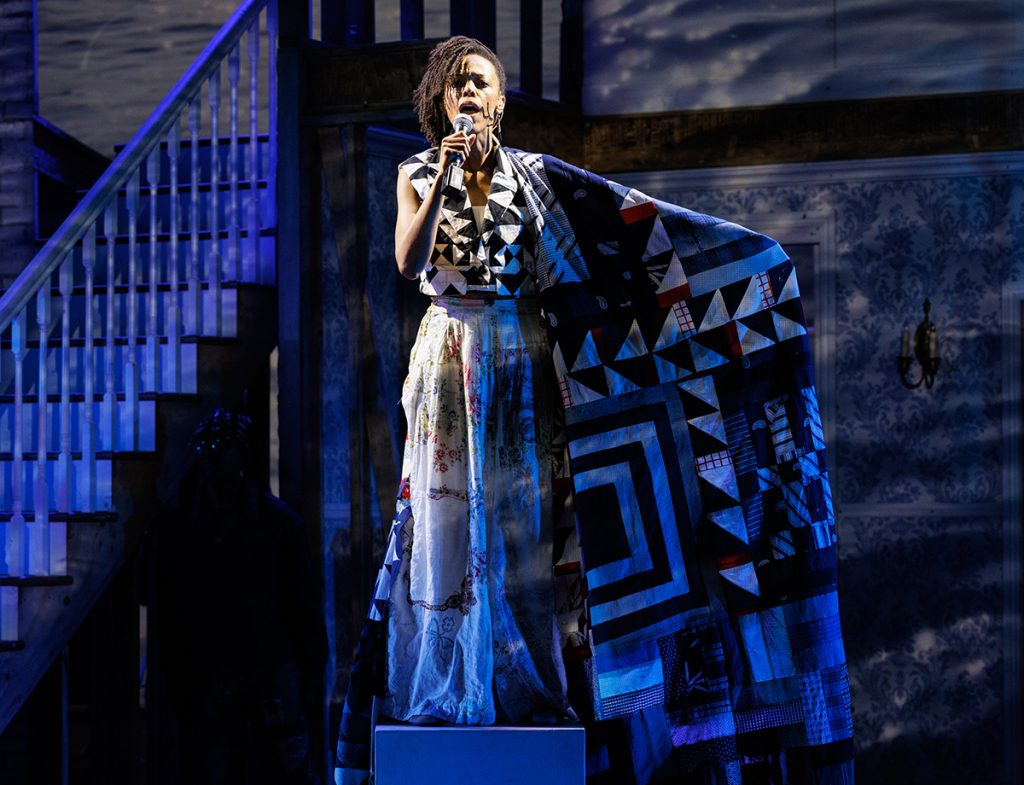
Photo by Maria Baranova-Suzuki -
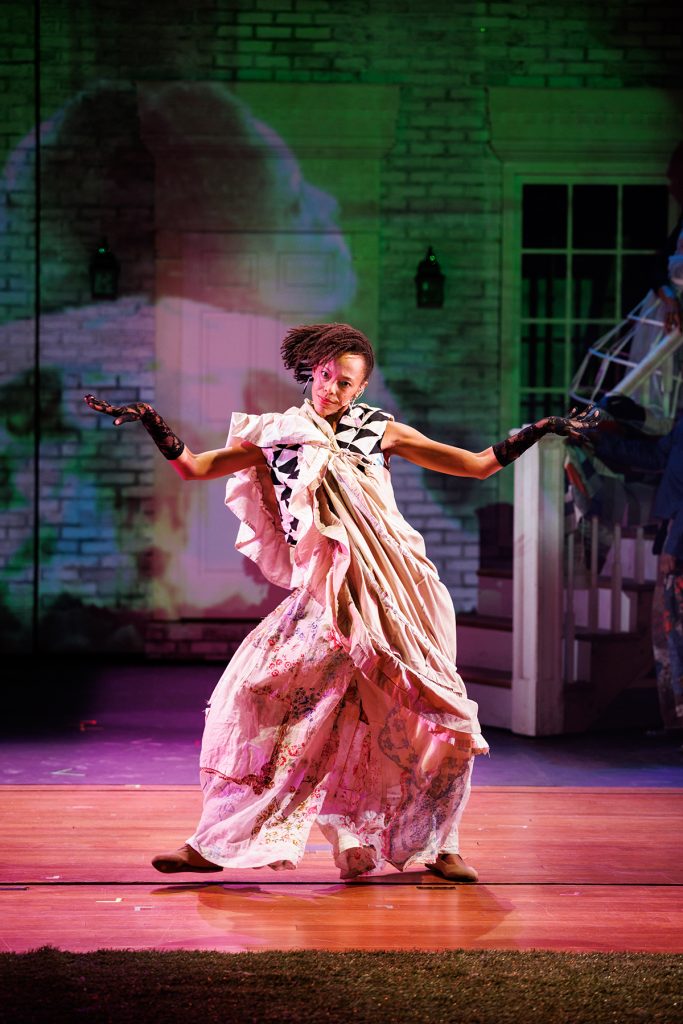
Photo by Maria Baranova-Suzuki -

Photo by Julieta Cerventes -
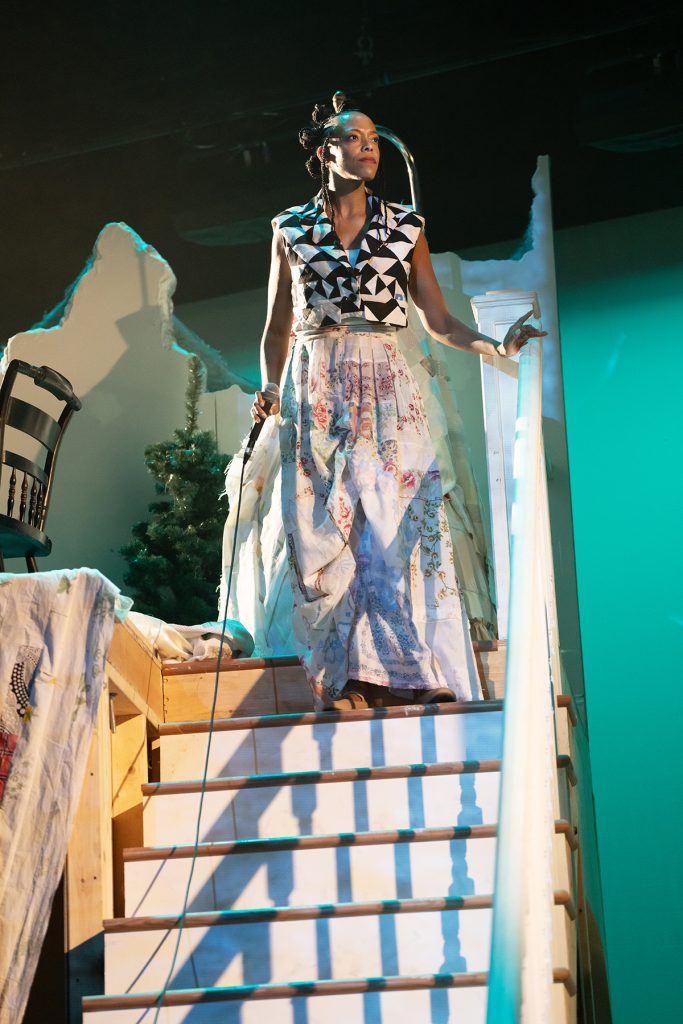
Photo by Julieta Cerventes
Photo by Maria Baranova-Suzuki
- To learn more about the quilting process for RECONSTRUCTING visit https://theteamplays.org/then-we-began-to-weave-road-to-reconstructing/ ↩︎