

Omar’s Dance Histories
by Amanda Jane Graham
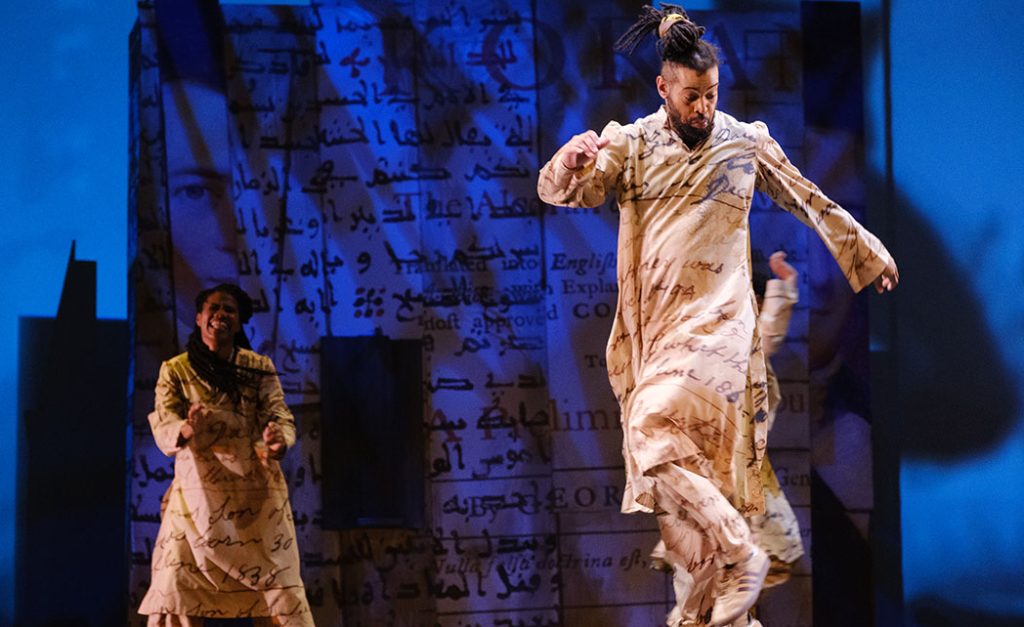
Maybe this is obvious, but operas are known for their music. A good opera generally balances the instrumental swells of the orchestra and the deep or high vocal dives of the singers. These forces combined contribute to the effective presentation of the story. Less present in opera is another artistic medium: dance. However, Act 2, Scene 2 of Omar not only features a dance; it demonstrates that dance can contribute to and complicate the telling of an historically based narrative. Set on an antebellum North Carolina plantation, this scene includes nearly the full Omar ensemble performing a square dance. The Caller/Katie Ellen (played by Catherine Ann Daniel) directs the group’s ever changing formation. As Omar (played by Jamez McCorkle) and fellow enslaved folks line up, circle, and do-si-do on stage, they are joined by they are joined by Black dancers from archival dance films.
Projected on a large screen center stage, the Omar dance film montage represents several contemporary and historical social and theatrical Black dance forms, and notable Black dancers. Among the dancers represented is Talley Beatty (1918-1995), who trained with Katherine Dunham and Martha Graham and became a principal dancer in Dunham’s Company at age sixteen. Beatty formed his own touring dance company, and received a Tony Award nomination as Best Choreographer for Your Arm’s Too Short to Box with God (1977). As a dance cultural historian who long taught classes on dance film, the Omar dance film montage clips of Beatty’s outstretched arms, which visually echo the birch tree branches in his wooded surroundings, immediately conjure the entirety of filmmaker Maya Deren’s avant-garde classic A Study in Choreography for Camera (1945). In A Study in Choreography for Camera Beatty appears to leap from one location to the next: a forest to an apartment to the Metropolitan Museum of Art. Due to Beatty’s performance, and Deren’s camerawork and editing, the film offers “a new geographical reality […] one where great distances can be covered within the span of […] minutes.”
Like A Study in Choreography for Camera, Omar moves its performers and audience across “great distances” within minutes. We travel from Omar Futa Toro in West Africa (present day Senegal) across The Middle Passage, to South and then North Carolina. In between those places we traverse imagined and hypothetical spaces of connection and joy that give Omar the vision and strength to persevere the traumas of an enslaved life. The square dance scene, with its accompanying archival montage dance film, is one such space. It serves to portray a Black celebration and ritual as a form of resistance, not only to the oppressive conditions of slavery, but also to white narratives, including those embedded in dance history. Square dance itself is often considered a white, American “folk” dance form. Scholars and artists (including Omar creator Rhiannon Giddens) have challenged this folk dance origin story by telling and, in the case of Omar, showing that square dance developed in Black communities. However, the white supremacist narratives of folk dance persist. Relatedly, the inclusion of Beatty’s modern dance moves in the Omar dance film underscore the fact that Black dancers and dance have long intersected and informed American modern dance, a form conventionally associated with white choreographers.
This is all to say that Omar may be billed as an opera, but, at least for me, it was a compelling, multimedia intervention in dance histories. Circle up and do-si-do, excavate history, here we go…
-
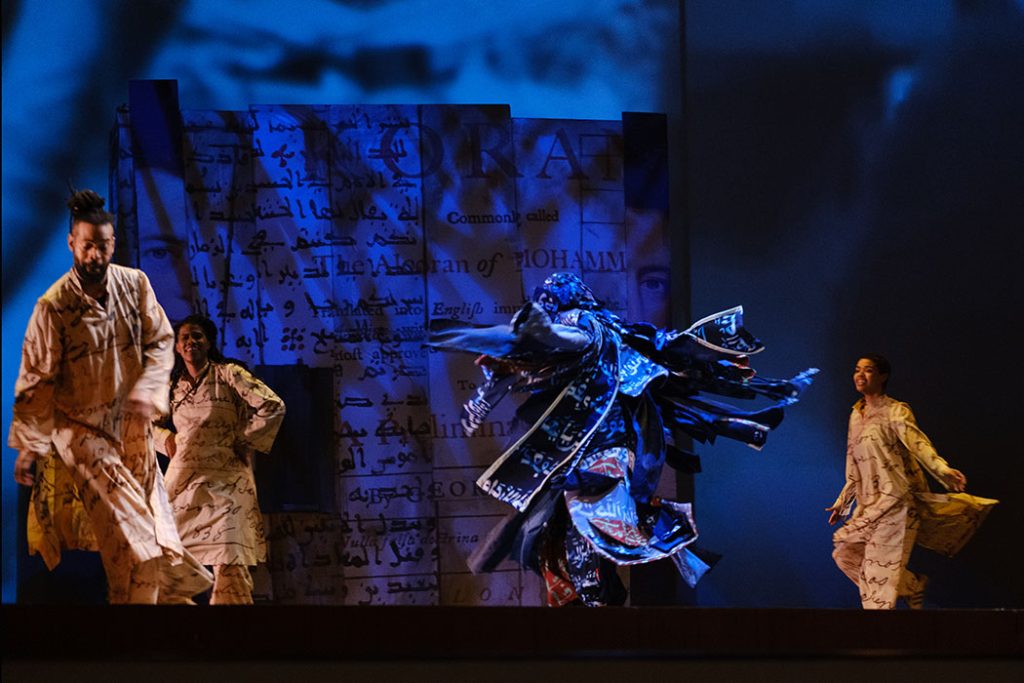
The Spirit dances on stage. Photo by Kent Corley. -

Omar dancers. Photo by Kent Corley. -

Omar chorus members dancing. Photo by Kent Corley. -
Omar dancers. Photo by Kent Corley.
“With black American culture you cannot separate the dance from the music; they’re a shared experience. You can’t have anything that goes into the folklore of the music without going into the folklore of the movement that’s a part of it because they tend to always meet each other. They essentially move together.”
Brian Polite, Omar Choreographer and Dancer