

Sounding the Shadows as Omar Engages the Past and the Present
By Naomi André, Department of Music, UNC
The story of Omar ibn Said fits into what I’ve come to think of as a Shadow Culture narrative. I use this term to describe something that was happening at the same time as the mainstream history we have come to know, yet has been hidden from sight.[1] Omar ibn Said (c. 1770-1863) is someone whom, until recently, most of us had never heard of before in textbooks from primary or secondary school. Yet he is part of our history. His life was documented in an autobiography he wrote in Arabic, an obituary that appeared in The North Carolina Standard (five paragraphs from August 19, 1863), and additional documents in his handwriting that have survived.[2] These materials are part of archival collections in the Wilson Library at UNC Chapel Hill, the Library of Congress, Yale University Libraries, Andover Theological Seminary, and perhaps other places that have yet to be recovered and made public. An exciting and unexpected development is that Omar’s story, his being and the contours of his existence, have been made into flesh and are now embodied in an opera. For many, this opera has brought Omar ibn Said out of the shadows and into a culturally meaningful position.
As a genre that was the brainchild of a bunch of intellectuals outside of Florence, Italy in the late sixteenth century, opera was invented to infuse music with a deep sense of feeling and emotion. Late Renaissance thinkers were inspired by such a power in music from their reading of ancient Greek manuscripts (including Plato’s Republic and Aristotle’s Poetics). Through live performance, opera was created to be a medium in which the past, through historical or mythological stories, could be given an immediacy and intimacy in the present. Of course, opera also embellishes and weaves in elements of fiction; it is a performance on stage. However, even in the most outrageous plots, the genre of opera has always entwined an element of truth through its ability to generate genuine feelings and emotions.
Omar the opera brings real history to life. Rhiannon Giddens and Michael Abels have taken words from the page and made Omar a breathing person when too frequently the humanity of enslaved people has been erased. They have written a counternarrative to the ones we were taught and believed, and that kept lives such as Omar’s in the shadows. Through the historical character of Omar and the community around him in the opera, Giddens and Abels have humanized a few of the many nameless numbers.
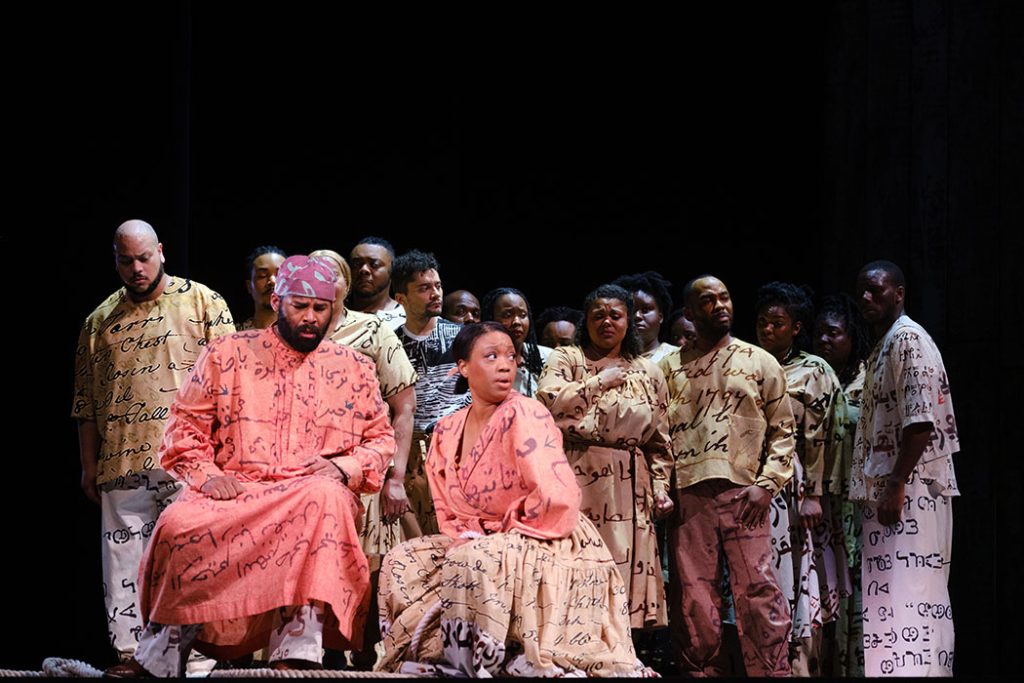
We now have a story that presents the facts about a 37-year-old man whose life began in Futa Torro (modern day Senegal) and belonged to the culture and community of the Fulani. His education spanned 25 years, some of which was with his older brother; indeed, we learn that Omar was part of an educated family. Even after he was captured and enslaved in the US, we learn that he had many passages of the Quran memorized and he wrote eloquently and elegantly in Arabic. Several surviving examples and accounts reveal his literacy: his writing on the walls of his cell in Fayetteville, NC jail (when he was captured after he escaped his first abusive owner in South Carolina), his autobiography from 1831, and many solicited written souvenirs. Several of these samples are held in archives; tellingly, the writer of his obituary (in The North Carolina Standard) mentions that once, when meeting Omar, “he gave us a specimen of his composition in Arabic, which though not equal in beauty to others we have seen written earlier in his life, does credit to his penmanship of the ancient language.”[3] Visually, in the opera production directed by Kaneza Schaal, Omar’s handwriting has been reproduced on the fabrics of the costumes and suspended tapestries as a tangible way to highlight a very material emblem of his existence.
In her libretto for the opera, Giddens weaves together the facts so that we can witness, understand, and learn Omar’s story. Enhanced through the orchestral score, Giddens and Abels have created a sonic landscape that has an aural resonance with the times being depicted. In the West African scenes, Omar’s music is largely modal with repeated ostinato figures in the orchestra. In the second act on the plantation the music is in a more traditional western harmony with choral-based melodies. As a model to capture a sound of the antebellum South some of the score uses the harmonic vocabulary and style reminiscent of minstrel music, an early extremely popular form of American music that was widely known and circulated in print. Both Giddens and Abels have Presbyterian and Methodist church hymns in their backgrounds, and this is also infused into the music of James Owen (Omar’s second owner) as well as in the community scenes. One of these scenes includes a frolic that attests to Black involvement in line, square, and other group dances that have been passed down into the present.
Reconstructing a life and community for Omar ibn Said allows us to feel a deeper sense of the humanity of the enslaved. With such hidden stories now out of the shadows and center-staged, a larger portion of today’s audiences can see ourselves in our past and be better equipped to move forward into a welcoming future.[4]
[1] I developed this term (Black Shadow Culture operas and narratives) and discuss it in Black Opera: History, Power, Engagement, Champagne Urbana, Illinois (2018).
[2] Link to obituary in Library of Congress: https://chroniclingamerica.loc.gov/lccn/sn83045706/1863-08-19/ed-1/seq-2/?loclr=blogloc
[3] Quoted from Omar’s obituary in The North Carolina Standard (August 19, 1863, Library of Congress: https://chroniclingamerica.loc.gov/lccn/sn83045706/1863-08-19/ed-1/seq-2/?loclr=blogloc )
[4] These last sentences intentionally riff on sentences on the Southern Futures website, a quotation from Jacqueline Lawton, 2023-2022 Co-Director of Southern Futures and Associate Professor of Dramatic Art: “Southern Futures works to disrupt stereotypes of the American South and create a bold, new, radically inclusive vision for who we are and who we can be. In doing so, we will be better equipped to face the truths of our past and the consequences of our actions and inactions, however painful, and bring about much-needed change for our future.” https://southernfuturescpa.org/about-southern-futures/