

Inspired by Ocean Vuong: Student Poetry
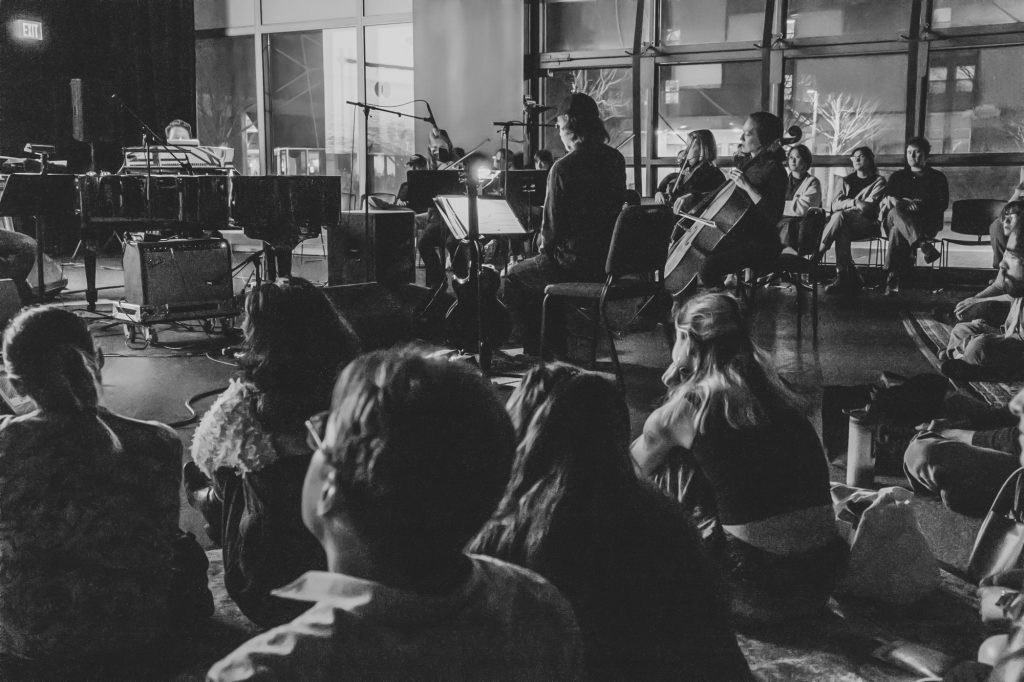
English and Comparative Literature faculty member Carlina Duan brought her Intermediate Poetry class to Night Sky with Exit Wounds. The class had read Vuong’s work and was excited to engage with the poetry and the subject matter in a new form. Professor Duan designed her class as part poetry workshop, part immersive craft-based experience. The class built on tools acquired in the intro-level poetry class while diving deeper into sub genres of poetry. The students took field trips across campus throughout the semester, including visits to the artists book collections in the Sloane Art Library, the Ackland Art Museum, the North Carolina Collection at Wilson Library, and Night Sky with Exit Wounds at Carolina Performing Arts. After each trip, they wrote poetry based off things and stories they encountered.
Prior to experiencing the Night Sky with Exit Wounds in-progress showing, the students read Vuong’s work of the same title. For many, it was the first time reading a contemporary full-length poetry book. The students engaged in conversations about how to read a whole book of poetry, wrote 2-3 poems inspired by the book, and attended the performance at CPA. The group of poets was, as Professor Duan put it, ‘generatively haunted’ by the evening’s performance, finding themselves inspired by the instrumentation. They were particularly struck by the relationship between white space on a page and how that can be translated into sonic form and found it inspiring to see poetic language living in other artistic forms.
Below are reflections and poetry by several students from Professor Duan’s poetry class.
‘A January on Fire’ by adam edge
The idea for “A January On Fire” came to me after reading Ocean Vuong’s “Seventh Circle of Earth.” I was fascinated by everything about that poem, from the incredibly unique and intriguing form to the intentional layout of the numbers on the page, to the dark and tragic subject matter. It was one of the most haunting, meaningful, impactful, and original poems I had ever read, and I knew I had to give Vuong’s footnote form a try.
When I went to see the Night Sky With Exit Wounds opera performance, I was blown away by how Vuong’s poetry had been expanded so far beyond the page. Hearing his poetry in conversation with music that came from bombshells used in the Vietnam War and Fleur Barron’s angelic voice truly elevated my perception of what poetry could become, and how it could be presented, communicated, and responded to. This performance inspired me to try my own hand at multimodal poetics, and I ended up drafting a visual representation of this poem that emphasized its core themes and expanded the narrative beyond the page. Overall, seeing this opera was extremely impactful for me, and I would love to see more poetry presented in this beautiful and unique way. — Adam Edge
‘Phantom Feelings’ by Natalie Bozza
Ocean Vuong’s Night Sky with Exit Wounds’ operatic transformation in the libretto performance emphasized the innate musicality of poetry and its versatility as an art form. Before the performance, I often wrote poetry securely in my comfort zone, restrained by traditional stanzas and rhymes. However, the libretto performance taught me that poetry does not have to rhyme to be musical, nor do unconventional structures have to be disorienting. The performance flowed seamlessly from spoken segments to soaring song, revealing the connectedness of poetry and music and offering new ways to perceive Vuong’s writing. With auditory components of vibrato and crescendo/decrescendo, I experienced a more enriching emotional journey and found myself drawn to different phrases than in my reading of Vuong’s work.
Since the libretto, I’ve been motivated to write poetry in eccentric forms that cater towards natural sound rather than forced structure. I’ve also been inspired to transform my poetry into song-form by identifying moments of innate musicality and crafting melodies around them. Overall, this experience cultivated in me a new poetic perspective that points towards natural rhythm and calls me to search for emotional layers within poetry that can be found in seamless musical transformation, as seen firsthand in the libretto performance. — Natalie Bozza
‘My Best Friend Writes from the bar’ by tabitha woolcott
Two of the most stunning and impactful components of Vuong’s work are the musical quality of his language and his use of form. His style directly harnesses sight and sound, alongside prose, as vehicles for imparting meaning, conveying emotion, and providing extra spaces for the reader to develop and explore their own reaction to the poem’s themes. In “Seventh Circle of Earth”, the fluttering ashes and empty space left behind by a burned house are seen in numbers trailing sparsely down the page, connoting to footnotes which spread the poem out in a heap of ash, silenced; “Aubade with Burning City” weaves snatches of a Christmas carol between language that varies between harsh and soft sounds to capture the ebb and flow of the fall of Saigon.
Vuong’s use of poetry as a starting point that reaches towards others arts totally captivated me as a reader and poet, and the libretto adaptation of “Night Sky with Exit Wounds” was a spellbinding expansion of this. Every component of the performance was investigated as a potential source of meaning: from the materials of its instruments to its visual accompaniment, the overall experience brought Vuong’s tour-de-force collection to a new level of beauty and intensity. I took so much joy in the way so many different forms of art, history and expertise came together, and attending the libretto certainly inspired me to take more risks within my own work, to search for ways to connect poetry with the many other methods of making meaning we encounter in our daily lives.
‘Someday I’ll love’ Alivia Weum
Attending Vuong libretto by Bryce Dessner and Kaneza Schaal was an incredibly valuable experience in understanding poetic performance from a musical perspective. I appreciated how the vocal and instrumental performance deepened my understanding of poetic musicality, shifting my interpretations of Vuong’s pieces through varying dynamics, tempos, and enunciation. The experience allowed me the opportunity to ponder the musical choices behind each piece’s performance, encouraging me to become introspective about my own poetry and how one might interpret the dynamics and rhythm of my words from vocal and instrumental angles, rather than the traditional spoken-word performance I’m familiar with. These new perspectives made the writing process increasingly rewarding as I enjoyed the performance’s representation of both poetry and music’s ability to breathe life into each other, working together in conversation.