

Sounds of Eclipse
As the audience-participants of Eclipse entered the dimly lit ArtSpace and took their seats in the circle, they were grounded in place by an audio introduction adapted from Reesma Menakem practice book ” My grand-mother’s hands”. This meditation invited participants to imagine themselves floating above planet Earth, moving closer and closer toward their seated bodies, descending to take in the United States, North Carolina, Chapel Hill, and finally their own bodies seated in a circle at the ArtSpace.
After this meditation, the audience-participants in the ArtSpace were enveloped in the soft sounds of bricks and crackling fire. The performance progressed as each person placed their brick in the center of the circle and then positioned their body within the circle’s bounds. The sound, too, grew with layers of voices and low frequencies.
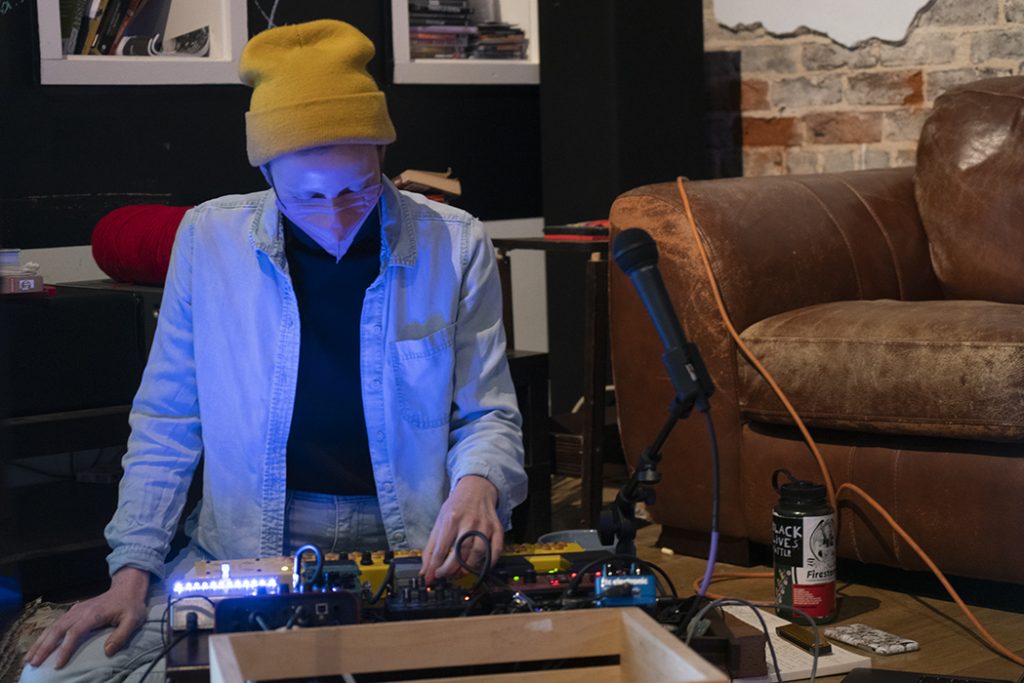
Caitlyn Swett served as the sound designer for Eclipse. Swett, a dancer, approached the sound for Eclipse by “creating a kind of map or a score of different anchors in time.” These sonic anchors came from oral histories collected by the Southern Oral History Program at UNC’s Center for the Study of the American South. Alexandra Ripp, the dramaturge for Eclipse, combed through the SOHP collection to source interviews that could ground people in the place of Chapel Hill, which surrounds and includes the ArtSpace. As Caitlyn listened to the oral histories selected by Alexandra, she noticed some telling patterns: “There was so much more to those stories than the place. There was also the impact of what had occurred in place over time. It felt important to bring that part of their stories into the work too.” The inclusion of participant voices felt especially important to Caitlyn, as “another white person” choosing which stories were told. “This was the thing that I really sat with while working with those interviews, and I wanted to do the best that I could and approach it with the most care and intention I could while knowing there would inherently be blind spots.”
Between the vocal anchors, Caitlyn sought to create a sonic spaciousness that enabled listeners to explore and “move through the practice and the work” within Eclipse. The practice and work referred to here were both complex elements. The practice was one of connecting with a place and its history through the body and its senses. The work was a process of digesting and internalizing this connection in tandem with the information communicated through CJ’s monologue (link below) and Jasmine and Otto’s dance.
To create Eclipse, Murielle and Tommy explored fire and brick sounds. Caitlyn aided this process by delving into the intricacies of brickmaking. She compared modern methods with the pre-industrial methods used by enslaved laborers at the University. In her research, Caitlyn found pre-recorded sounds of fire and bricks, bricks coming in contact with one another during the laying process, and bricks grinding together. Not all of the soundscape’s elements were pre-recorded. Caitlyn also sourced a sample of Murielle walking on a pallet of bricks. She then layered these brick-generated sounds with a very low sense frequency that was “kind of like the sound of a kiln.”
Caitlyn reflected that in “a lot of this work, especially in CJ’s text, there was this going back, and back, and back in time and also deeper, and deeper, and deeper in the earth. The audience members were holding these bricks that were getting heavier and heavier. I feel like that heavier delay on the sound of fire also suspended us in this way.” Ultimately, the sonic element of the performance acted as both an enveloping and a grounding agent as participants navigated the rocky terrain of excavating a past that is still very much present.
Listen to the Score from Eclipse:
Southern Oral History Interviews
Discover the full-length interviews from the SOHP that Caitlyn used to create the soundscape of Eclipse:
Caitlyn’s sound map
This document is Caitlyn’s sound map. She used this map to guide when she would play different sounds during the performance of Eclipse. The sound score to Eclipse was live, meaning that Caitlyn was actively constructing a soundscape in real-time during each performance: