

A Performance and a practice

Eclipse was a participatory performance held at the Joan H. Gillings CURRENT ArtSpace in April 2022. The experience included bricks from UNC facilities, a monologue about the 180-year history of the land outside Gillings CURRENT ArtSpace, place-based meditations, and a communal navigation of space, time, and history. Eclipse was also a practice—one of re-learning a familiar place through somatic experience and restorative justice.
The Performance
Several Eclipse artists stood outside the CURRENT ArtSpace & Studio beside a pallet of stacked red bricks. As each audience-participant arrived, they were greeted by an artist and offered a single brick weighing 5lbs. They were invited to feel the heft of the brick in their hands. This brick was theirs to hold, carry, and tend for the next 45 minutes. If they needed help carrying their brick, they could ask for it. The artists then invited the participants to wander out onto the lawn of CURRENT. The participants were instructed to notice everything. Audience-participants paced the lawn, stood in place, and laid on the grass to watch the clouds pass. Over the course of 15–30 minutes, thirty audience-participants arrived and navigated the lawn with their bricks, together and separately.
-
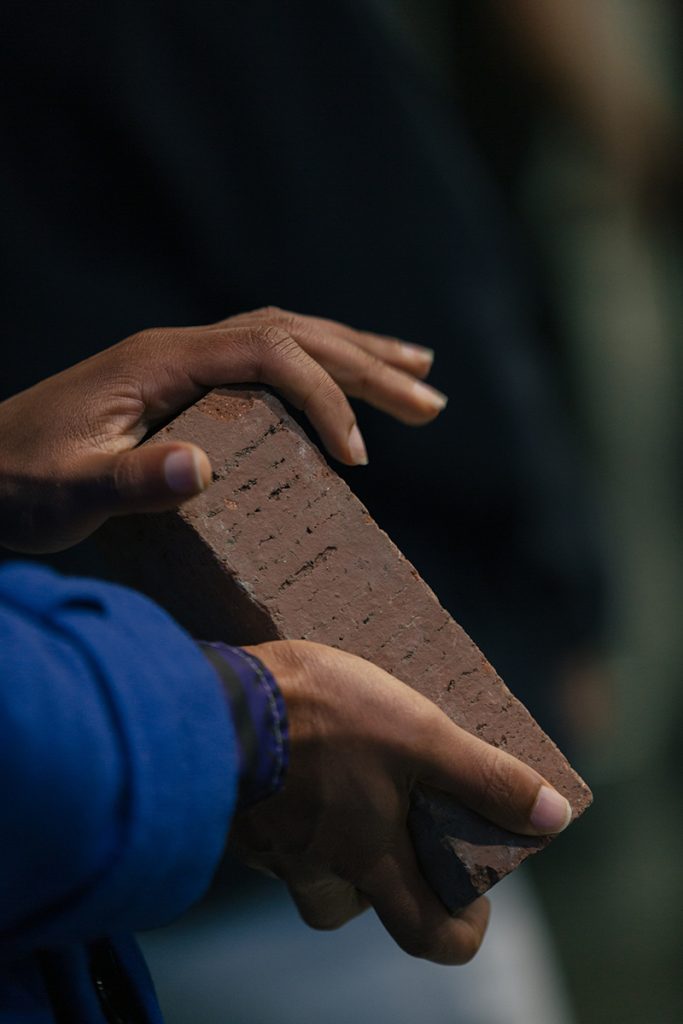
A brick in hand. Photo By Shannon Kelly. -
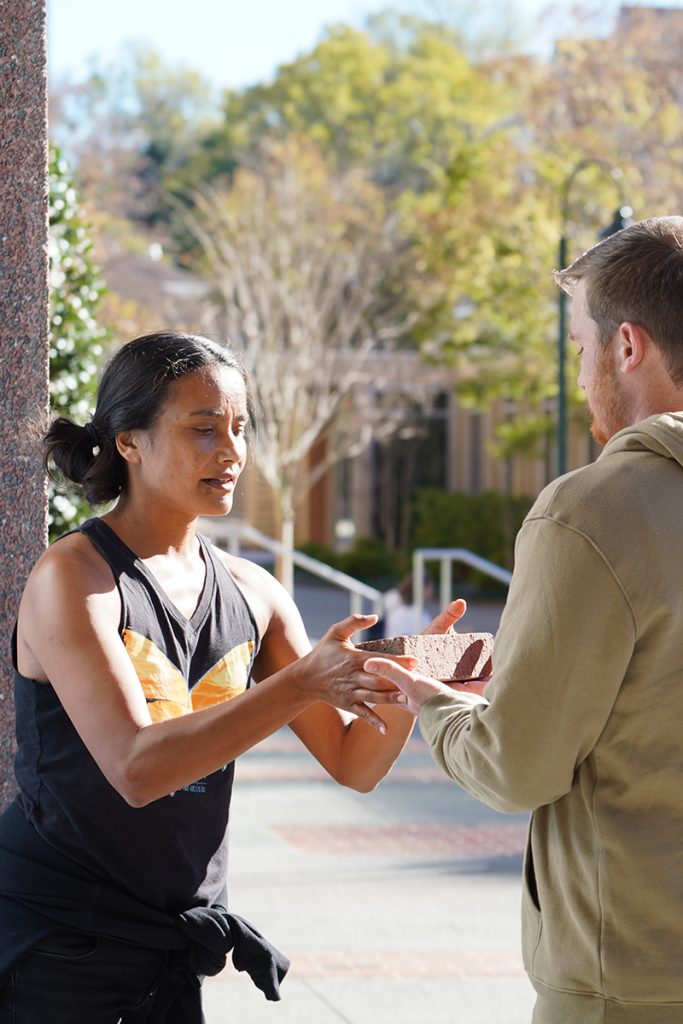
Murielle hands a brick to a participant. Photo by Taylor Barrett. -
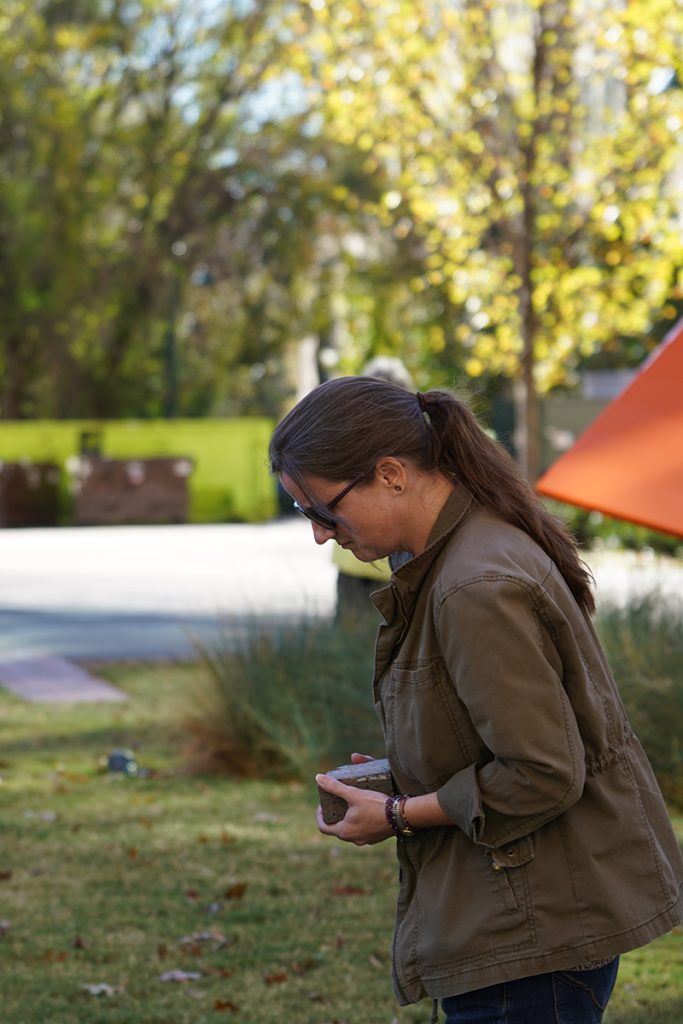
Val Hanson holds a brick on CURRENT lawn. Photo by Taylor Barrett. -

CJ Suit delivers his monologue. Photo by Shannon Kelly. -
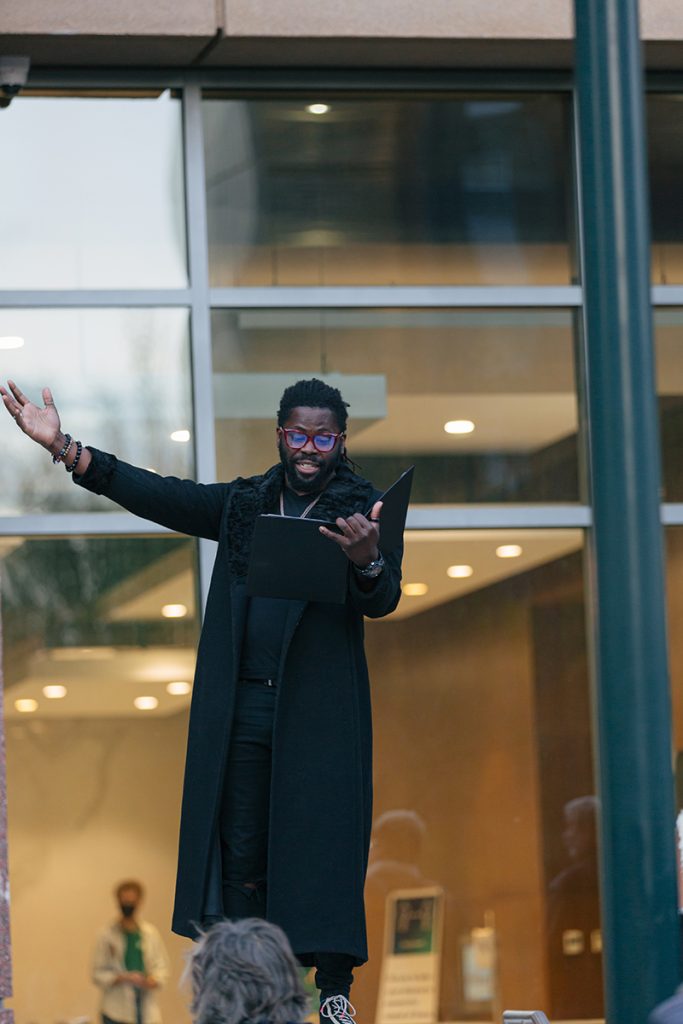
CJ delivers his monologue. Photo by Shannon Kelly.
Once everyone had arrived and settled on the lawn, poet and facilitator CJ Suitt leapt upon a stone pillar wall along the CURRENT walkway and asked the group to assemble below. CJ soon launched into his opening monologue. He began by expressing his thanks to Carolina Performing Arts for hosting the group at CURRENT Artspace & Studio. As the speech continued, he gave thanks to increasingly obscure organizations, acknowledging the many corporations and entities connected to the land: CBRE properties, the affluent UNC students renting the apartments around CURRENT, Chapel Hill Foundation Real Estate Holdings, the UNC-Chapel Hill Foundation, and more. 15 minutes in, it became clear that he was not simply giving thanks, but rather painstakingly illustrating the chain of powerful organizations and corporations who control and claim the land upon which CURRENT sits.
Read the text from Eclipse
CJ gave mere moments for this information to sink in before ushering the group into the lobby of the ArtSpace and continuing with his archaeological monologue. He asked those present if anyone could remember the area before 123 West Franklin Street existed. What was there? Most recently, it was a parking lot for University Square, a small business district that housed restaurants and stores. Over the previous 200 years, the land had been owned by half a dozen wealthy, white individuals, many with strong ties to the University and the town of Chapel Hill. CJ brought his listeners back through time, connecting pivotal moments of the nation’s history (the Vietnam War, the Great Depression, Westward settler-colonial expansion) with the varying incarnations of the land upon which they stood. Throughout its history, the land had hosted Granville Towers (a Carolina student dormitory), the original Chapel Hill High School (a white-only, segregated school), and an old wooden home designed by N.C. builder and enslaver Jacob W. Holt.
Midway through his monologue, CJ pointed toward the orange metal sculpture at the center of the lawn and invited audience-participants to imagine three cottages there. He informed the audience that these cottages once housed the enslaved Black laborers and craftspeople who spent their entire lives working to build the University. Then, he shared a pertinent fact: at the time when these cottages existed, the University had a policy that prohibited students and faculty from bringing their own enslaved laborers to campus. However, CJ said, these student and faculty members were allowed to rent enslaved workers from the University to help with work like foundation repair, roofing, or … making bricks. Thus, it is quite conceivable that the very individuals who lived in these cottages may have turned Carolina red clay into the bricks that built the oldest public University in America. Without their contributions, and the revenue reaped from the state’s sale of enslaved people—distributed to the University through the process of escheatment—the fledgling flagship University would have failed to succeed. Bringing that past into the present, CJ informed his listeners that “whenever UNC renovates a building, any historical bricks are always kept and placed back into the structure.” The original bricks are never discarded. In this moment, the weight of each brick took on new meaning.
-

Eclipse participants listen to CJ in the lobby of CURRENT Artspace & Studio. Photo by Shannon Kelly. -
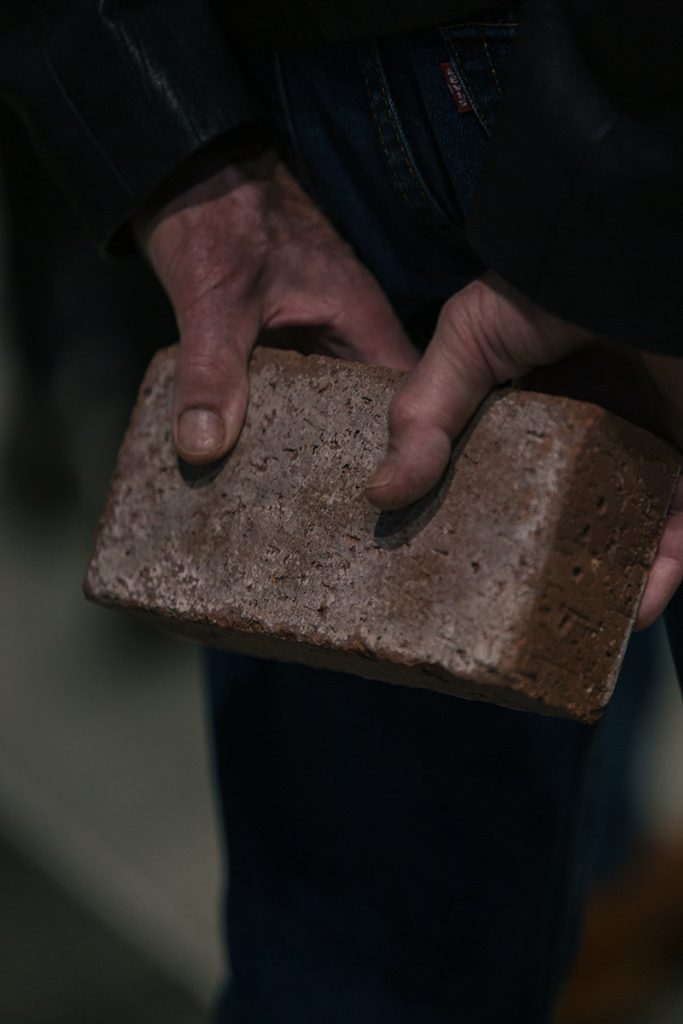
A participant holds a brick behind their back. Photo by Shannon Kelly. -

Danny Cowan holds a brick. -

A pallet of bricks. Photo by Shannon Kelly.
Weighed down by the heaviness of history and their bricks, the audience shuffled from the brightly lit lobby into the dark, quiet ArtSpace. 40 chairs were arranged in a circle around a pile of bricks, which sat on the floor in the center of the room. A fire-like orange light bathed the space. “Sit anywhere you like,” CJ instructed, and the audience-participants settled into their seats. An audio introduction began to play. Poet Mtende Roll’s soft voice filled the air. The introduction began with an offering to orient oneself to the space and people within CURRENT ArtSpace. It then guided participants to imagine themselves floating above the United States. Gradually, the meditation invited the participants to descend, taking in the world from increasingly localized perspectives, until they finally slipped back into their bodies seated in the circle. Another voice, that of Restorative Justice facilitator Val Hanson, echoed in the space: “Let us notice gravity in our bricks. One by one, we will place our bricks in the center. When you are finished, look to the person to your left.”
Eclipse artists were interspersed within the group, where they could actively join the ritual and model possible behaviors such as brick-placing or passing on one’s turn. The choreography asked facilitator Val Hanson to place her brick first. One by one, in silence, participants stood up, walked to the center of the circle, and placed their brick among the others. Some approached the arrangement slowly, circling the formation, pausing to decide where their brick should go. Others moved quickly, entering and exiting the circle’s center in a matter of moments. In many cases, participants followed the instructions, signaling to their neighbor with a leftward look that their turn was over. This eye contact encouraged participants to acknowledge each other as they navigated space and history collectively. In some instances, a person would move bricks that their fellow attendees had already placed, tempting others to read into their actions. During one performance, two participants helped each other to rearrange all the bricks into an altar-like formation. The first evening, a participant placed their brick so quickly that the facilitator was not the first to place the brick. This led to a semi-haphazard approach on the part of the participants; some opted not to move around the circle, as in other performances. This is the awkward magic of participatory art. Together, the Eclipse participants and artists mirrored the ways in which a society or community might navigate shared histories and spaces. There can, of course, be guidelines for movement and action, but there is an equally inherent unpredictability to a group of strangers engaging in a new ritual.
-

A participant reaches for their brick. Photo by Shannon Kelly. -

-
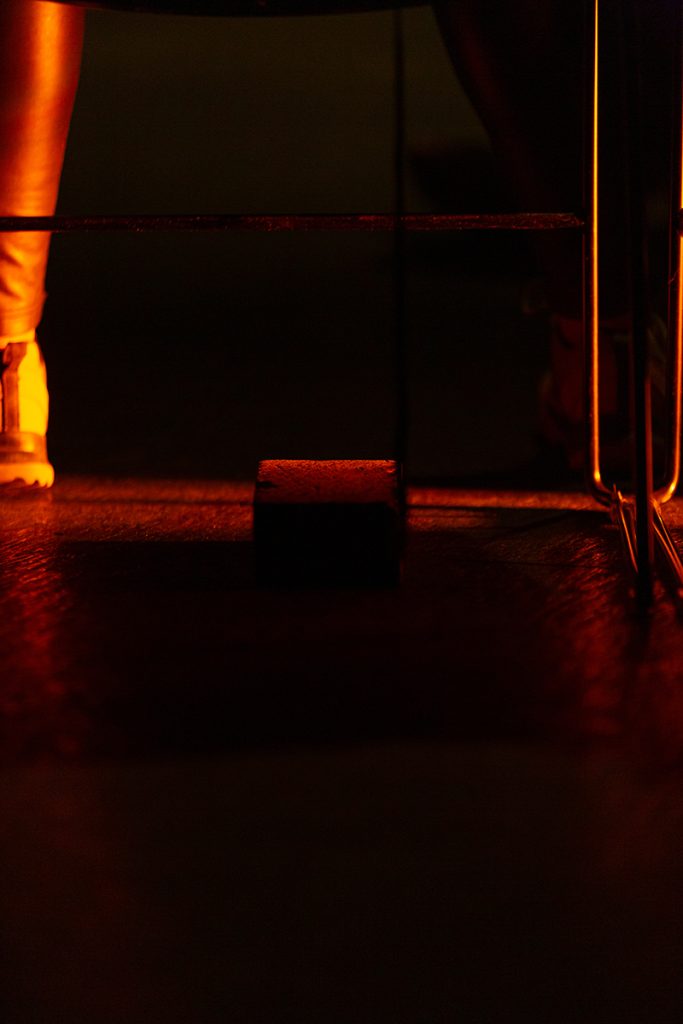
A brick beneath a chair. Photo by Shannon Kelly. -

Jamine Powell places her brick. Photo by Shannon Kelly. -

Jasmine Powell approaches the circle's center with her brick. Photo by Shannon Kelly.
Throughout the performance, sound artist Caitlyn Swett created a soft, live soundscape. The sounds of bricks, crackling fire, field recordings from the Old Chapel Hill Cemetery, and local voices from the Southern Oral History Program enveloped the room. This sonic element of Eclipse suspended time, connected participants to place, and built a supportive space for the artists and the audience to move through the practice of Eclipse.
Read more about the sounds of Eclipse here .
With everyone now brick-less and back in their seats, another recorded voice (that of Murielle Elizéon) offered instructions: “Let us now notice gravity in our bodies. One by one, we will place ourselves in the space. When you are finished, look to the next person. It’s always ok to pass, and to take care of your body.” Facilitator Val Hanson began this new phase of the ritual, striding into the circle, stopping, and looking back at her neighbor to signal it was their turn. Some participants stood along the circle’s periphery, while others laid down on the floor, close to the assembled bricks. Some people sat or stood close to their fellow participants, and others attempted to carve out personal space. When everyone had placed their bodies in the circle, one person was left seated at the top of the circle. This person was dancer Anthony “Otto” Nelson Jr. Otto stood on his chair and gazed into the distance. The harmonic tones from Caitlyn’s soundboard swelled. The dance of Eclipse began.
Dancer Jasmine Powell left her place in the circle. She wove between bodies, never shying away from taking up space or making eye contact. As she moved through the room, Otto descended from his chair and crawled across the floor toward the pile of bricks. Eventually, Jasmine and Otto came to stand across from each other with the pile of bricks between them. Their eyes met. For the next half hour, the two moved around, over, and between the bricks and bodies, translating the weight of living in a Black body within a country and upon a land where humanity has never been equally granted. Otto stacked bricks on one shoulder, swaying and struggling beneath the accumulating weight. Jasmine perched on a small pile of bricks and curled into herself. As the dance progressed, Otto’s movements became sharper and more erratic. He slammed bricks together repeatedly and exerted force, upsetting the pile. Exhausted, he yielded to Jasmine’s touch. She took his head in her hands and placed it tenderly upon a brick to rest.
Then, Otto and Jasmine rose in unison, locking eyes as they slowly backed away. Jasmine moved toward the interior wall, and Otto backed toward the opposing wall, which was covered by a thick black curtain. The curtain rose to reveal a wall of glass. The wall of the ArtSpace opened with a groan, exposing the kiln-like space to the crisp night air. Otto continued his backward stride. Barefoot, he exited the ArtSpace and headed down the stone steps, toward the lawn where the performance had begun three hours before. This “slow walk,” as Culture Mill and Otto called it, was a sensing practice that allowed Otto to cultivate energetic “tethers” between himself and the others involved in the ritual. These tethers, cultivated through eye contact and shared energy, provided Otto a support system to aid his journey out of the ArtSpace and into the world. As he slow-walked, Otto worked to expand his awareness and connect with all the lives, bodies, and materials that defined Eclipse: the history, the architecture, the bricks, his fellow artists, the participants, and everything else, all swirled together. When he crossed the threshold of the ArtSpace, Jasmine raised her arms and began to follow, inviting the other artists and participants to progress toward the lawn. Tommy’s voice came across the speakers: “In silence, let us collect our personal belongings and slowly walk outside. We will notice everything.”
-

-

-
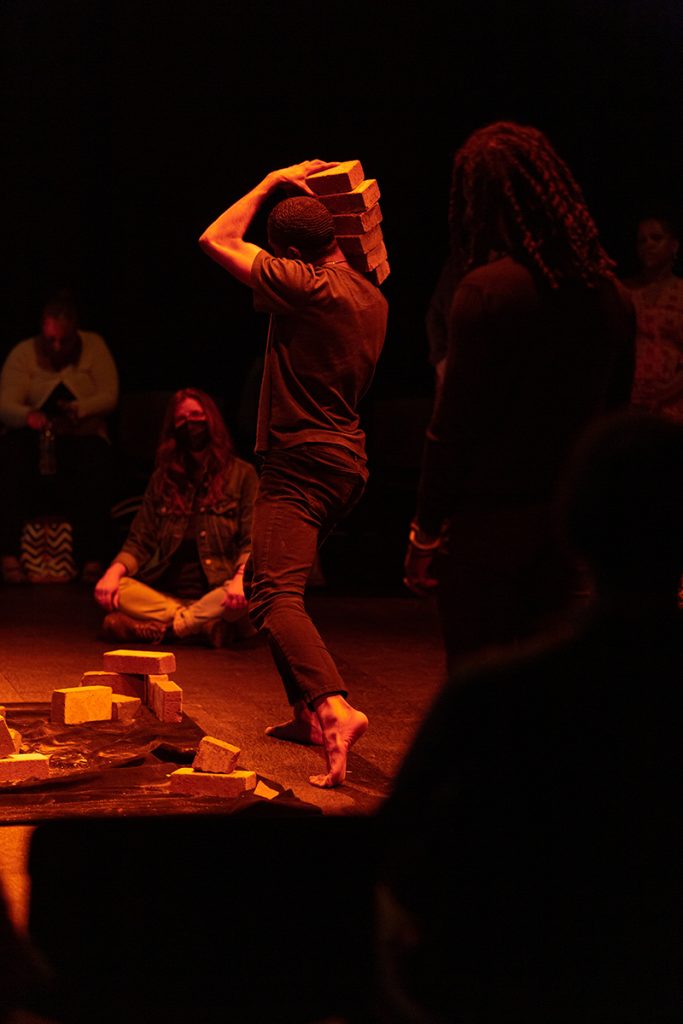
Anthony 'Otto' Nelson Jr. Photo by Shannon Kelley. -
Jasmine Powell and Anthony 'Otto' Nelson Jr. dance upon the pile of bricks. Photo by Shannon Kelly. -

The participants and artists made their way out into the night. Jasmine did not join as expected. Instead, she climbed atop the bricks, balancing and swaying, lifting her arms in a final dance. Otto, at the far end of the lawn, and Jasmine, teetering with simultaneous power and vulnerability upon the pile inside, created a forceful connection between the bricks and the former location of the cottages. As the participants slowly walked between the two dancers, CJ closed the evening with a final poem. With CJ’s voice echoing across the lawn and into the night, the garage door roared shut and the curtains drew together, eclipsing Jasmine from view. Eclipse the performance was over, but for those in attendance, the practice had just begun.
-
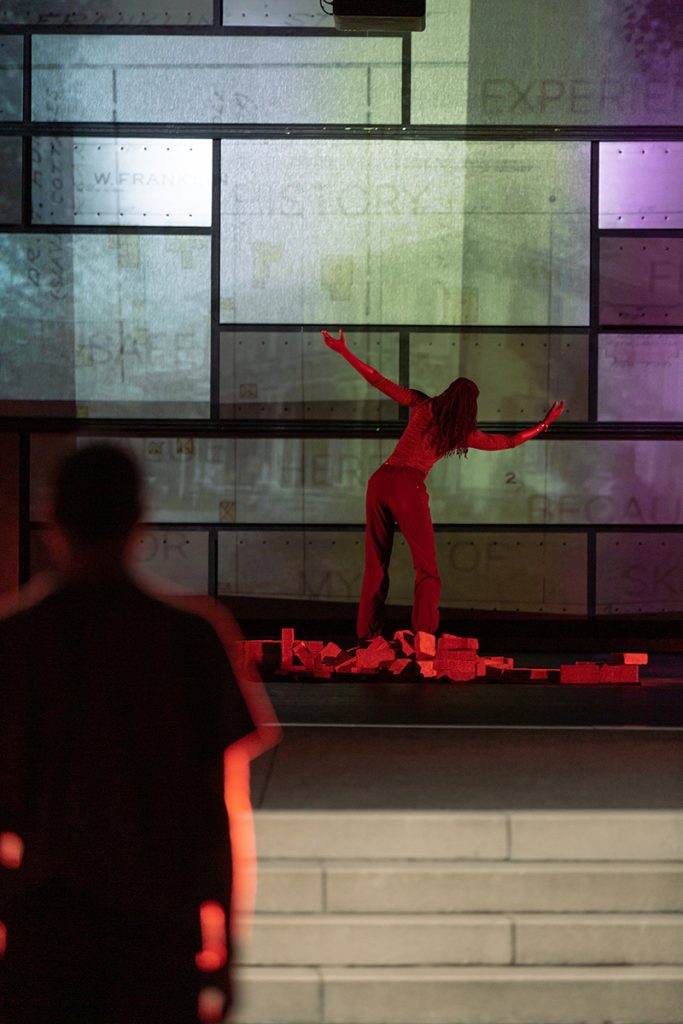
Jasmine atop the pile of bricks. Photo by Shannon Kelly. -

Otto looks up at the sky from the lawn outside CURRENT ArtSpace. Photo by Shannon Kelly. -

CJs talks with a participant. Photo by Shannon Kelly. -
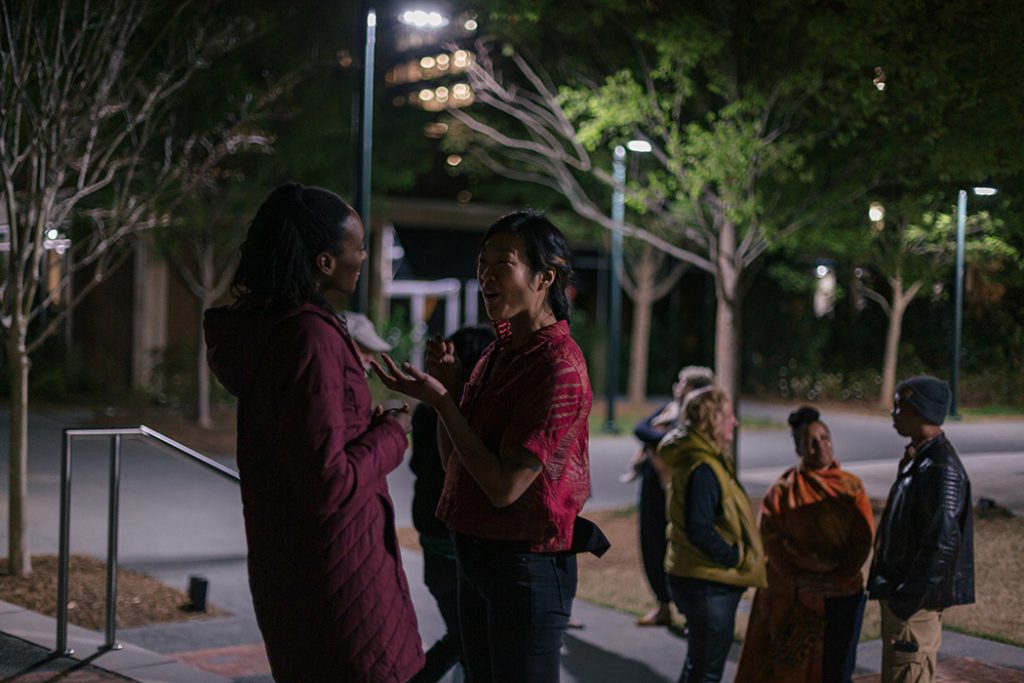
Jasmine and Paura after Eclipse. Photo by Shannon Kelly. -

Murielle and others after Eclipse. Photo by Shannon Kelly. -
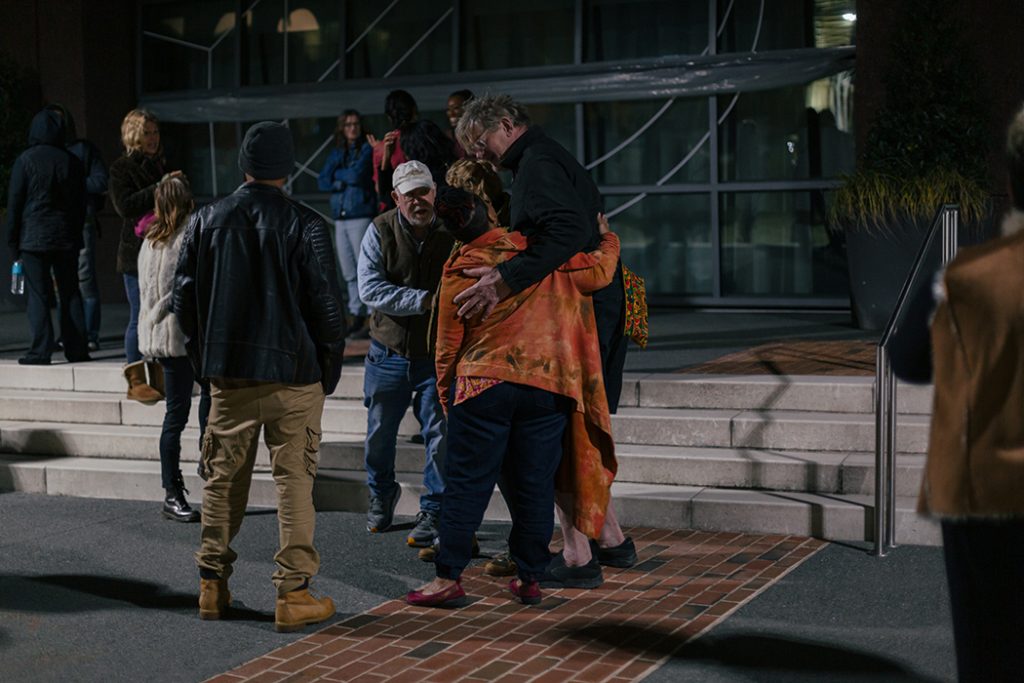
Folks embrace after Eclipse. Photo by Shannon Kelly.
The Practice
What does it mean to practice something? To “practice” means to carry out habitually, or to perform repeatedly in an effort to improve or deepen one’s ability. When we talk about the act of practicing, or establishing a practice, we gesture at ideas like commitment and growth. At the heart of practice is willing, continued participation—a pursuit of betterment, rather than mastery. In this spirit, Eclipse is a practice of community learning, of knowing history and place through the body. It is a practice of noticing and healing in community.
Murielle and Tommy describe the practice of Eclipse as one of “being in our bodies and being together across lines of difference.” Eclipse is a practice of “considering the body and its relationship to place: thinking of place and how it speaks to the idea of the body in that place.” Eclipse invites participants and artists alike to consider the body, to consider their bodies in relationship to place. What would it mean if we were to place primacy and importance on the body when thinking of places and their histories? This is a question that the practice of Eclipse seeks to answer.
It was important to Tommy and Murielle that somatic and embodied practices be foundational to Eclipse. “We often learn … historical information, and it remains there on a cognitive, intellectual level,” says Tommy. “The possibility to prime our bodies to feel through time that history and the landing of that history on our bodies and in this place was more important than the simple delivery of information.” In Eclipse, the artists and the participants strive toward new forms of knowing, raising the sensing body to the same level as the thinking brain.
Culture Mill, with the guidance of Val Hanson, incorporated tools of Restorative Justice while building the practice of Eclipse. They did this to ensure that the practice and performance of Eclipse were inclusive of all voices and experiences present. Traditionally, when we learn history, it is from a top-down perspective, meaning that we look to experts to teach us what once happened. Eclipse is a practice of learning history through diffused authority, honoring everyone’s individual expertise and experiences as valid and essential. Equally as important is the practice of honoring difference in experiences: that the history and politics Eclipse takes up lands differently within each body. One way that Tommy and Murielle borrowed from Restorative Justice practices was through the driftwood circle practice. In Restorative Justice, there is a practice in which a group of people go around in a circle and rearrange a pile of driftwood one-by-one. They do so in silence. In this practice, a community of people must arrive at an end point, and the facilitator of the activity must relinquish their own power to choose or dictate the outcome. The group embraces distributive power, accommodating for every single person, as well as the choices and histories that feed into the experience. This driftwood practice served as a seed for Eclipse. If Eclipse as a project is about creating a new kind of monument, ever-expanding and ever-dependent on those involved, Eclipse as a practice must necessarily consider who those people are and how each person’s embodied experience is honored.
Eclipse is a practice that makes space for grief to exist in community. In Eclipse the learning of painful information about the past is paired with the space and time to physically and emotionally processes the information with the support of a group of people. It is a practice of slowly expanding the circle, inviting more and more people to experience history and place with their bodies, and to consider what there is to learn through nontraditional, somatic practices of knowledge-gathering. It is a practice of trust-building, and one of community care, intended to build bridges between the past and present, between bodies in the here and now. It is a process without an end.